
.png)


Optics11 develops fibre optic sensing systems that help protect electricity grids and critical underwater infrastructure. The company received the Innovation Champion Award at the European Investment Bank's Summit. In its energy division, the sensors detect and locate partial discharge inside transformers and other high-voltage assets, giving operators earlier warning of developing faults.
More customers, more questions for the same specialists
An engineer in a transformer factory and an asset manager monitoring equipment need different kinds of support. Some customers are partial discharge specialists. Others need more guidance to understand the information Optics11's systems provide. Even experienced users still need help with the product itself.
Optics11 already supplied manuals and how-to guides. Questions continued to reach the applications team, often about the same steps. Those specialists were also travelling to customer sites and supporting deployments, so an email arriving from another time zone could mean a wait for an answer.

And so, what we found is that even though we provide manuals and documentation and how-to guides, these teams were still contacting us. - Jamie Bryson
Language added another obstacle. Much of the documentation was in English, while some operators worked in other languages. Optics11 wanted customers to be able to ask a question in their own language and find guidance from the same documentation its specialists would consult.
Why Optics11 chose Chapter
Optics11 considered building its own tool and using the knowledge base features in its service management software. The decision included the work that would follow: maintaining the tool while the team was already busy supporting customers.
Also, building something ourselves means that it's another thing that we have to maintain ourselves. - Jamie Bryson
Chapter's AI-native service knowledge base gave Optics11 a way to make its documentation available through questions and answers, with source references people could check. The team could also see where an answer needed more information and ask a specialist to add it. This meant the same work could improve support for the next person with that question.
Chapter passed Optics11's data security review, a key requirement for a company working with critical infrastructure and defence applications. The review addressed controlled access to source documents, separation between departments and how AI providers handle data. Chapter confirmed that neither it nor its model providers use those documents for training.
In Jamie's own words
“We looked at building our own tooling, but that would mean another thing to maintain ourselves. With Chapter, it was easy to load our information, use the system and add users.”
Building confidence with the applications team
The rollout began with a defined set of material: the current OptiFinder manuals, brochures and datasheets. At the September kickoff, colleagues logged in, asked questions and explored how to review answers and flag missing information.
The applications team was the first priority. Its members can use Chapter for technical lookups and check answers against the source material. Optics11 will use that experience to make the knowledge base ready for customers. Keeping the initial document selection narrow also lets the team control what information would be available outside the company.
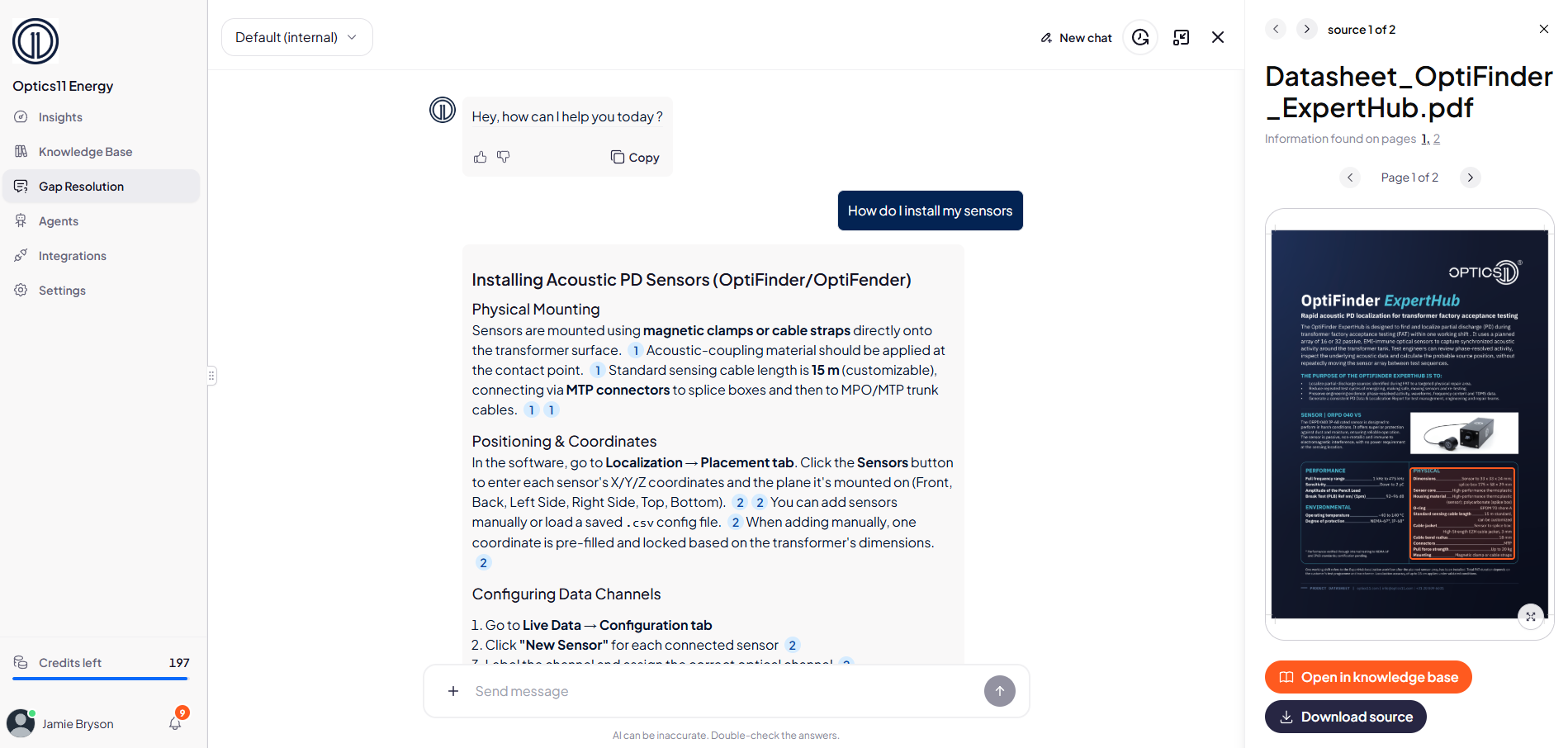
When an answer is incomplete, specialists can add a document, write a knowledge article or annotate existing material with missing context. That gives the team a way to capture an explanation that might otherwise stay in an email exchange.
Letting field experience guide the documentation
The conversations after kickoff made the documentation priorities more concrete. A recent deployment debrief had highlighted the need for a visual quick start guide and short videos showing how components connect and how to complete individual steps in OptiFinder.
Optics11 is adding those materials to Chapter as well to provide them directly to customers. Engineers would then have another way to find guidance on a particular step without searching through the full manual.
Chapter's view of repeated questions and knowledge gaps can help the team decide what to document next. Field debriefs bring the experience of the applications team, while questions in the knowledge base show where users still need help.
A straightforward start
For a team onboarding customers and managing deployments, ease of use mattered from the outset. In the launch interview, Jamie described the experience of adding information and inviting colleagues:
So for us, it was easy to load our context, load all of our information. The system was easy to use. It was easy to add users.

.png)
The immediate focus is regular use by the applications team. Optics11 is building confidence in the answers and expanding the documentation before assessing the effect on customer support requests.

The next test is specific: when a customer needs to configure a system or use an unfamiliar part of OptiFinder, can they find the guidance they need without sending another email to the applications team?
